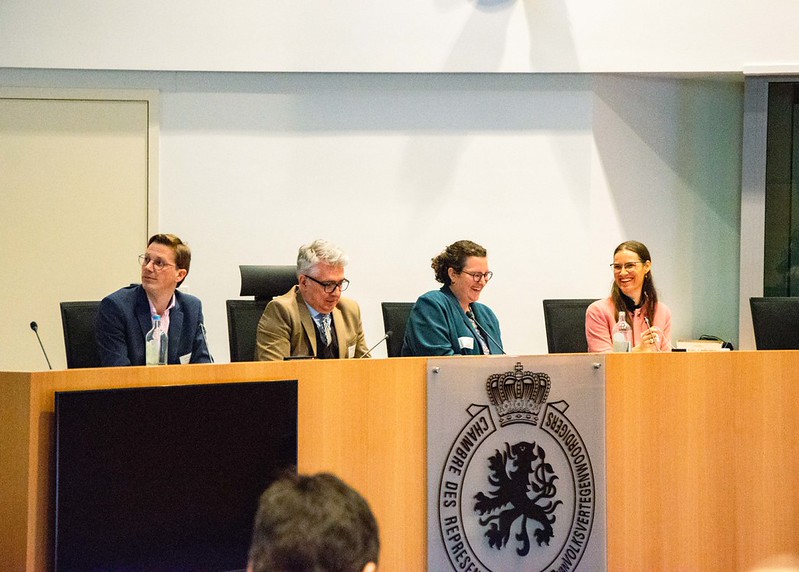
Last week, a coalition of over 100 Belgian stakeholders presented their position paper, ‘Towards a Secure and Sustainable Belgian Protein System’, to the Federal Parliament. Representing universities, civil society groups, retailers, and agricultural organisations from across the country, the coalition called for an ambitious protein action plan.
At the Federal Parliament, the coalition emphasised that proteins are essential to human health yet their production and consumption are increasingly affected by global and local challenges. These include geopolitical and economic uncertainty, pressure on farmers’ livelihoods (with many leaving the sector), rising living costs, climate change and biodiversity loss, and the rise of unhealthy diets. The coalition called for production and consumption to be diversified across a wider range of protein sources in order to create a resilient and secure food system.
According to experts present at the Federal Parliament, these essential objectives could be achieved by implementing a federal action plan for protein diversification, which would strengthen farmers’ position in local protein cultivation and drive innovation throughout the supply chain.
‘For the sake of our agriculture and food security, investing in innovation is urgent.’ said Meyrem Almaci, the Groen (Greens/EFA) MP who attended the launch of the initiative. ‘In Europe, subsidies for animal production are still four times higher than for plant-based production, based on outdated models.’
The position paper was introduced by the lead organisers, Bond Beter Leefmilieu and ProVeg Belgium (an EVU member), after which representatives from across the entire food supply chain shared their insights. Two representatives from the Walloon and Flemish Parliaments also joined the event: Christine Mauel from MR (Renew Europe) and Mien Van Olmen from CD&V (EPP).
A protein strategy is not new to Belgium, as a similar plan already exists in the Flemish region. However, ProVeg Belgium emphasises that realising the full potential of protein diversification requires a national approach. ‘To turn this potential into practice, a coherent policy is indispensable’ said Nicolas Vamvas Ferrandez, Policy Officer at ProVeg Belgium. ‘While a Flemish protein strategy exists and initiatives like Protewin are moving forward in Wallonia, this coalition is calling for better alignment and a unified Belgian plan that pools insights and sets clear national objectives’.
Advocates of the protein action plan highlight that it should address both the supply and demand of sustainable proteins and include coordinated policy support ranging from incentives to legislation across all relevant ministerial portfolios. The coalition of Belgian stakeholders highlight the Action Plan for Plant-Based Foods in Denmark as an example, emphasising the international importance of the topic and the growing European consensus that national plans and strategies for protein diversification and plant-based foods are essential.
“This recent Belgian development, built on consensus and broad support across different stakeholders, mirrors similar initiatives in other EU countries.” said Christine Leidner, Policy Manager at European Vegetarian Union. “These promising national developments should encourage the European Union to develop an ambitious protein strategy and, in addition, a specific Action Plan dedicated to the development of plant-based food chains across Europe.”
Find out more here on the ongoing campaign for an EU Plant-Based Action Plan.