PRESS RELEASE – FOR IMMEDIATE RELEASE
Brussels, November 10, 2026
PLANT-BASED FOODS SUBJECT TO “SYSTEMATIC FISCAL DISCRIMINATION”, NEW REPORT FINDS
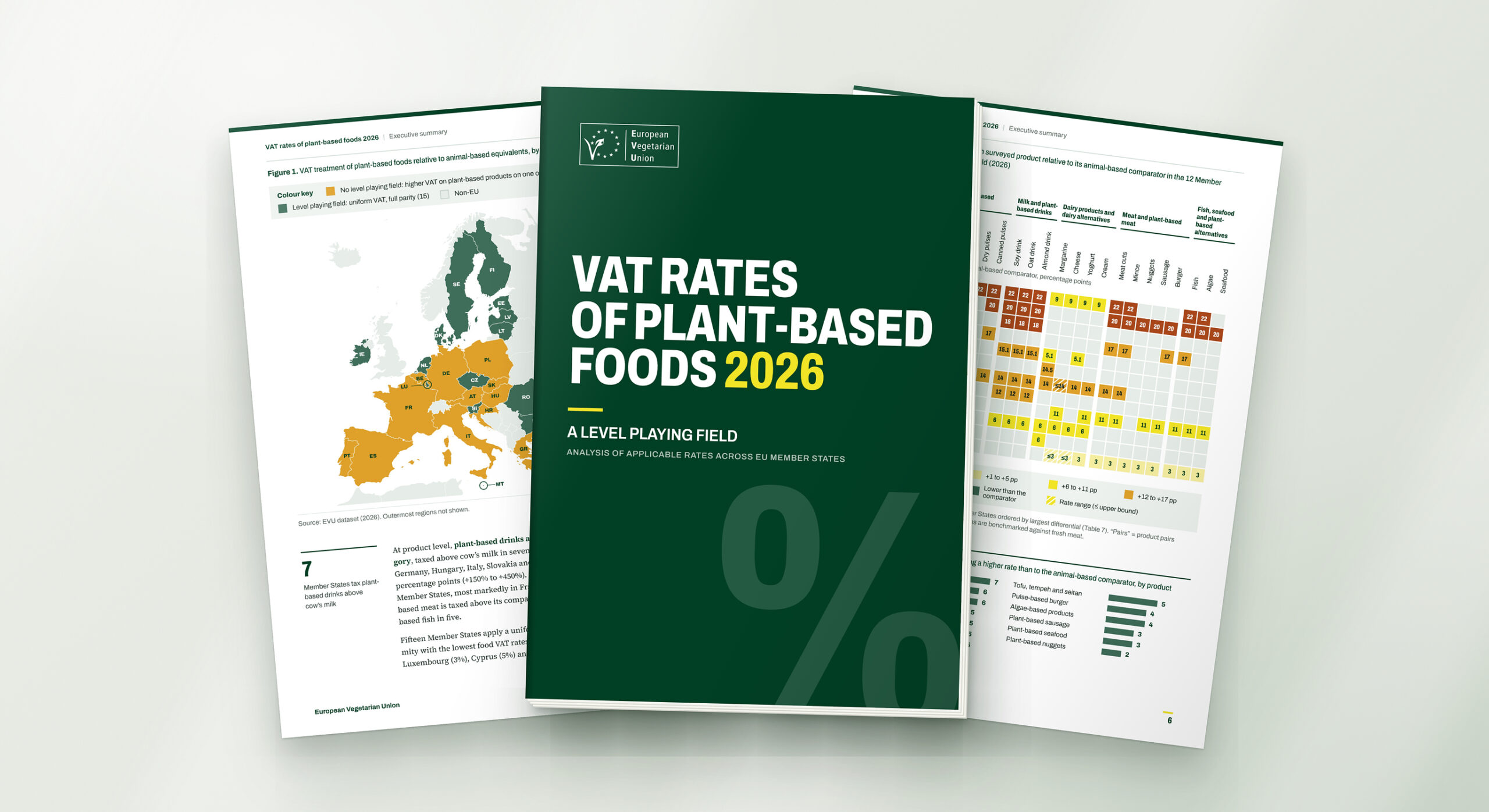
Brussels, 10 November 2026: 12 of the 27 EU Member States apply a higher VAT rate to at least one plant-based food than to its animal-based equivalent, according to VAT rates of plant-based foods 2026: a level playing field, published today by the European Vegetarian Union (EVU).
According to the report, in some Member-States differences can amount to up to a 21% higher price for plant-based foods at the checkout from VAT alone. The report compares 33 products in all 27 Member States, from plant-based drinks and cheese, to plant-based meat, tofu and pulses.
The Member States with the most significant overall tax differences include Hungary, Croatia, Italy and Portugal. The 15 Member States with parity apply the same tax rate to all food products and therefore naturally achieve balance.
Plant-based drinks are the most frequently affected product: they are taxed above cow’s milk in eight Member States (Austria, Croatia, Germany, Hungary, Italy, Romania, Slovakia and Spain). Meanwhile, plant-based meat alternatives have a higher tax in 5 Member States (Hungary, Croatia, Portugal, Slovakia and Poland).
“In a context where almost 40 million Europeans can’t afford a high protein meal every second day, this systematic fiscal discrimination of plant-based foods conditions consumers choices even more”, said Rafael Pinto, Senior Policy Manager at the European Vegetarian Union.
The EVU argues that VAT rates negatively influence food environments and nudge the consumers into choosing the animal-based options, “It’s only a free market and consumer choice if a level playing field exists. People who choose or need plant-based foods should not pay more tax for the same everyday function.”
The report highlights that significant tax differences may affect EU competitiveness and the single market. “It’s a complete mess! There’s no uniform pattern across the EU or even within the categories in the Member-States. The same oat drink is taxed at 6% in Belgium, 9% in the Netherlands (plus a beverage tax) and 19% in Germany. Soy drinks have 18 different VAT rates across the Member-States, from 0% to 27%. This leaves producers and consumers at a disadvantage in the higher tax countries and calls into question the integrity of the single market”.
The report finds that the gaps stem from national classification choices and calls for simplification of VAT rates in the sector. “We call on the European Commission to issue common guidance on how plant-based foods are classified for VAT, in line with the EU Protein Plan. We further call on the remaining twelve Member States to close the gap.”
Another key finding from the report is that traditional plant-based foods such as tofu, tempeh, seitan, dry and canned beans also suffer from VAT disadvantages in several Member-States, including miscellaneous differentials reported for Hungary, Croatia, Portugal, Slovakia and Poland.
On a positive note, in recent years, Czechia, Belgium and Portugal have expressly aligned the rate on plant-based drinks with that on cow’s milk, showcasing a trend towards uniformisation. Spain is the only Member-State with a positive differential on plant and animal protein, applying a super reduced rate of 4% to dry pulses, compared to 10% for meat.The distinction, however, does not include canned pulses.
Read the full report.
How to read the report:
→ VAT rates were collected by EVU member organisations and partners between March and August 2026. The report compares statutory retail VAT rates, not shelf prices, and excludes temporary measures and additional taxes, such as a beverage tax in the Netherlands;.
→ The analysis covers 15 direct product pairs (for example, oat drink and cow’s milk) and six traditional plant proteins compared with fresh meat.