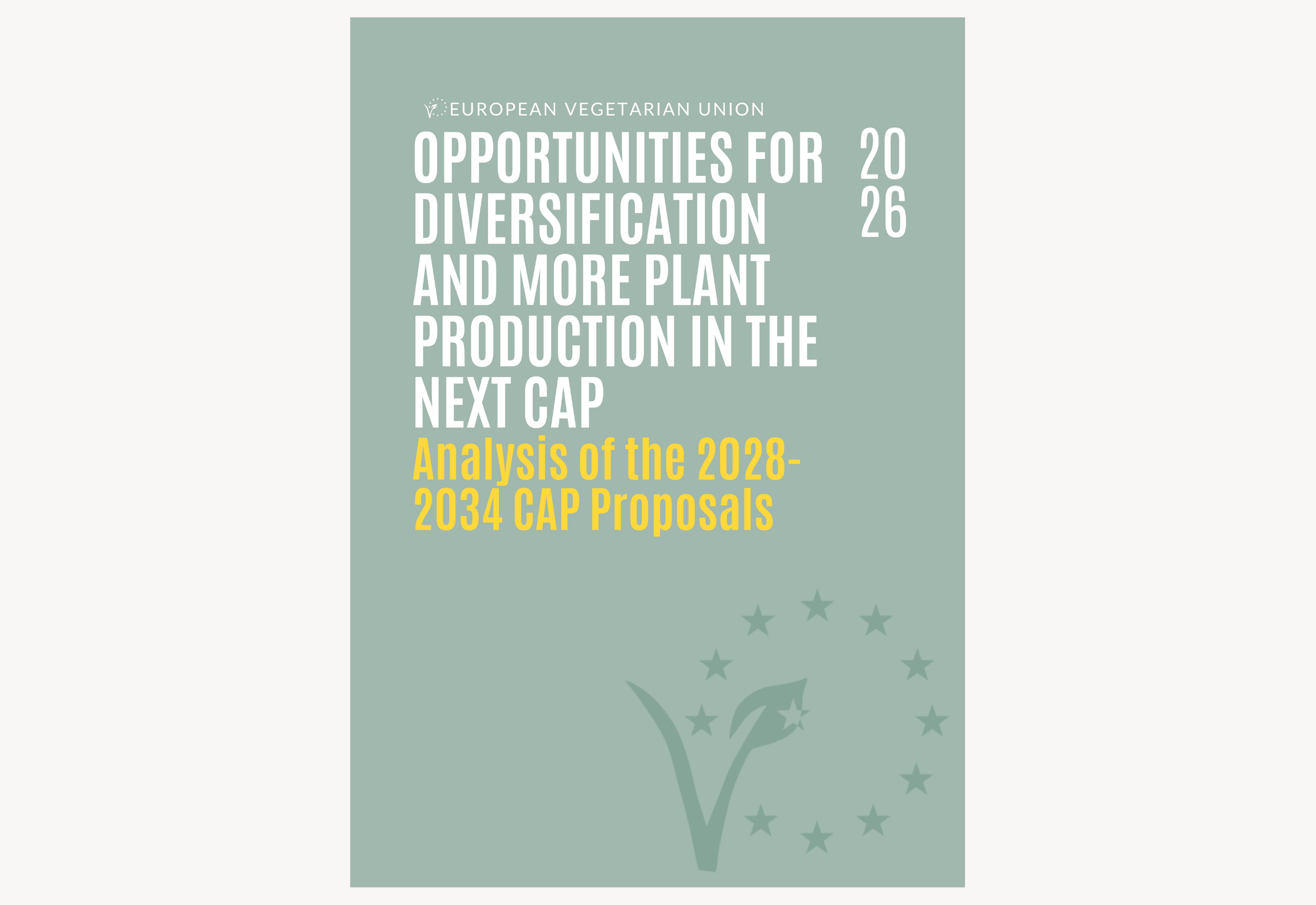
The European Vegetarian Union (EVU) has published a new analysis of the European Commission’s proposals for the 2028–2034 Common Agricultural Policy (CAP), with a particular focus on opportunities to strengthen agricultural diversification and plant and protein crop production across the EU.
Titled “Opportunities for Diversification and More Plant Production in the Next CAP: Analysis of the 2028–2034 CAP Proposals”, the paper examines key elements of the Commission’s proposals published in July 2025, including the Multiannual Financial Framework (MFF), the proposed National and Regional Partnership Fund (NRP), the new CAP regulation, and changes to the Common Market Organisation (CMO).
Assessing the CAP through a diversification and plant production lense
EVU set out to assess the CAP-related proposals – including the complex new budgetary structure proposed by the European Commission – through the lens of protein diversification and increased plant production. The analysis is guided by two core questions: whether the current proposals could create real opportunities for farmers to diversify and scale up plant-based food production, and which elements of the proposals would require improvement to ensure a more diverse, sustainable, and resilient European agricultural system.
The paper identifies eight promising elements within the proposals that could support diversification and the development of plant and protein crops, while also highlighting six areas of concern that risk limiting progress if left unaddressed. For each of these, EVU outlines concrete priorities and recommendations for negotiations and implementation of the next CAP.
Key findings: opportunities and risks in the CAP proposals
Among its key messages, EVU stresses that the next CAP must send a clear political signal that diversification and increased plant-based production are central to Europe’s food competitiveness and long-term resilience. Diversification, the paper argues, should not be treated as a niche or regional measure, but embedded systemically across CAP objectives, instruments, and monitoring frameworks.
Sufficient time, certainty and the right incentives
The analysis also underlines the importance of time, certainty, and de-risking for farmers. Multi-annual transition support, predictable investment aid, and strong advisory services are identified as essential tools to enable shifts towards more plant production. At the same time, EVU calls for a rebalancing of financial incentives, with coupled income support, investment aid, and redistribution mechanisms more clearly prioritising protein crops and sustainable plant production.
Building value chains and safeguarding EU-level ambition
Beyond production, the paper highlights the need to build functioning value chains. Establishing a dedicated protein sector under the CMO is seen as a key step to support processing, marketing, and promotion structures for protein crops intended for human consumption. Moreover, EVU warns against the risks of renationalisation and uneven competition, emphasising the need for strong EU-level common rules, environmental ambition and ringfenced funding. Finally, there is a need for long-term governance mechanisms that explicitly include protein diversification objectives, targets, and monitoring.
A critical moment for co-legislators
The European Commission’s proposals of relevance for the CAP 2028–2034 open up a number of promising avenues to support agricultural diversification and the development of plant-based and protein crop production in Europe. If designed and implemented well, new measures could help de-risk production shifts, strengthen value chains, improve farm resilience and meaningfully contribute to food security, environmental sustainability and generational renewal.
However, as currently drafted, the proposals risk falling short of these ambitions. The upcoming negotiations therefore represent a critical moment. Co-legislators have the opportunity to strengthen the proposals and ensure that diversification and increased plant-based production be positioned as central pillars of a resilient, competitive and future-proof European food system.
With negotiations on the future CAP assured to be complex and politically challenging, EVU’s new analysis aims to provide advocates and policymakers with a practical roadmap for aligning agricultural policy with sustainability, resilience and the growing demand for plant-rich foods made in Europe.
Read the executive briefing or explore the full analysis.