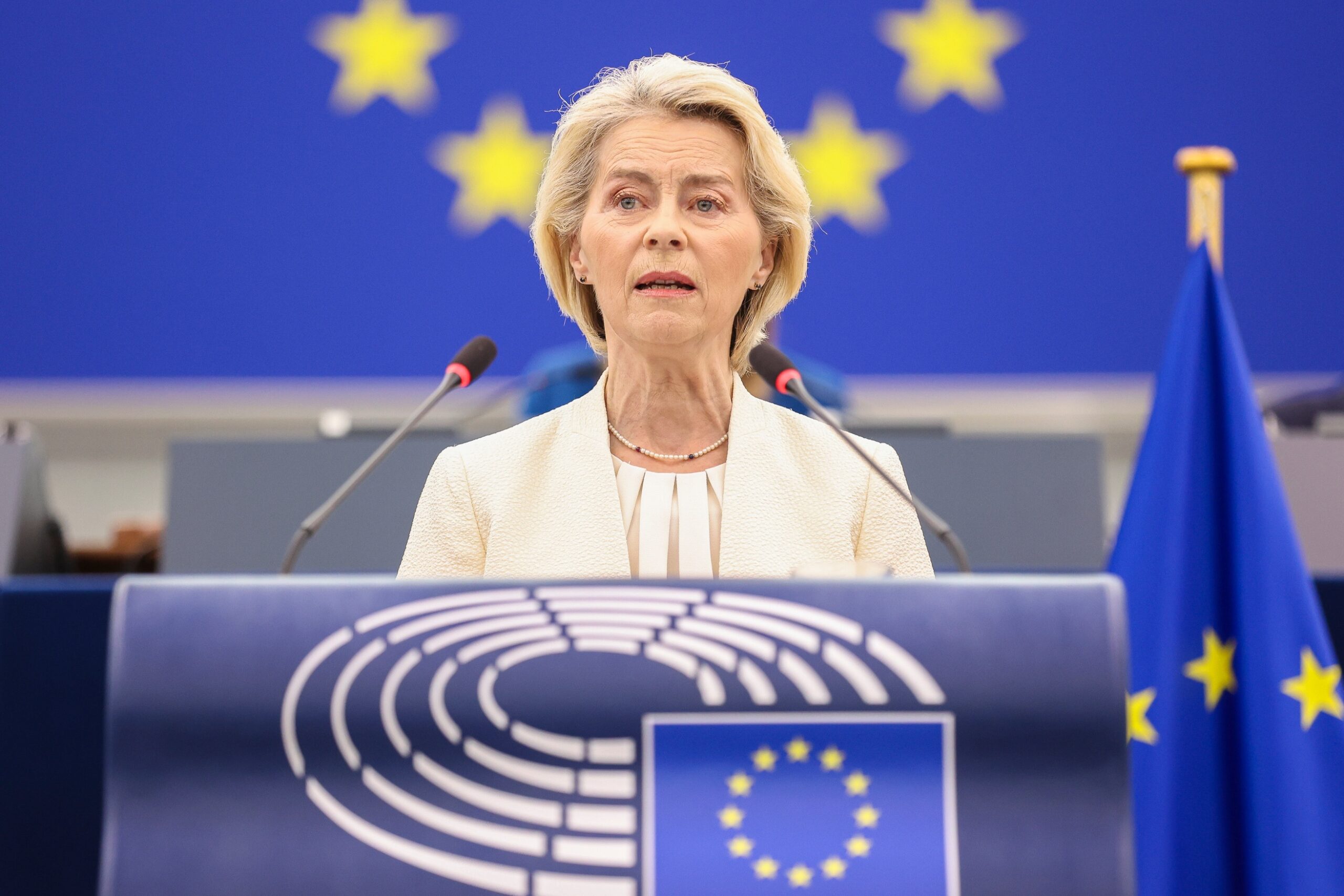
On 16 September, Ursula von der Leyen delivered her sixth State of the Union address in Strasbourg, setting out the Commission’s priorities regarding security, climate targets, the cost of living, competitiveness, and jobs. Although security was a key part of her speech, it did not include any measures on food security. Nor did it address food prices or the diversification of protein sources that the Commission’s Protein Plan calls for.
Security was about energy, not about food
The President made a strong case for a Europe run on homegrown clean electricity and for putting the last fossil fuel crisis behind us. Highlighting past mistakes on gas and fuel dependencies and investments that are today compromising EU’s sovereignty.
For decades, civil society organisations and scientists have been warning politicians that these investments would become liabilities and stranded assets that would hinder Europe’ future, both economically and ecologically. Although it seems like the EU has learned its lesson when it comes to energy, the same scenario is playing out in its food systems.
The current challenges to the EU’s energy and food security are similar. On one side, dependency on imports: where Europe imports fossil fuels, it also imports the protein that feeds animals, above all soy from South America, fertilizers (previously from Russia, now mainly from Egypt), and even vitamins and amino acids to enrich feed for farmed animals. On the other side, environmental destruction: fossil fuels and animal agriculture are the two largest drivers of climate change. The Union is upholding its climate target, but the speech contained no measures addressing food system emissions, which account for roughly a third of its total emissions.
“A Union that has learned what it means to depend on someone else for its energy should be able to recognise the same vulnerability when it comes to food”, said Rafael Pinto, Senior Policy Manager at the European Vegetarian Union.
Why food security means protein diversification
The threat to food security in the EU comes from, first and foremost, Europe’s imbalanced agricultural production and diets. As set out in the EU Protein Plan, 64% of the proteins consumed in the EU originate from animal sources, while the remaining 36% come from plant sources. The average global ratio is the reverse.
Growing more legumes, pulses and vegetables in Europe, and eating more of them directly, cuts import dependency, uses land and water far more efficiently (in line with the drought and water resilience worries echoed by the President), and reduces the environmental pressure that both animal agriculture and feed cropping place on European soils and water systems.
Climate targets will not be met on energy alone
The President was clear that Europe must deliver on its climate targets, and she announced a new framework for climate resilience, a European Heatwave Plan, a Climate Insurance Alliance and a new water initiative. Mitigation, however, was framed almost entirely around fossil fuels.
The science says that is not enough. Research led by the University of Oxford and published in Science found that even if greenhouse gas emissions from fossil fuels stopped immediately, emissions from the global food system alone would still push temperatures past 1.5°C without a shift towards more plant-based diets. The European Environment Agency and European Scientific Advisory Board on Climate have both backed up this finding, warning of the need for changes in protein production and consumption within the EU, moving towards plant proteins.
Problems named, solutions missing
European agriculture featured in the speech, but not as its pillar. The President recalled the 660,000 hectares burnt and the roughly 12 million tonnes of crops lost this summer, and announced measures on water risk management and the insurance gap. Farmers and the challenges facing agriculture were also raised by the leaders of the political groups during the debate that followed, though mostly as one item on a long list of problems.
However, no concrete measures and no structural proposals were put forward to reduce farming’s exposure to future droughts. Insurance and early warning systems are essential, but they only manage the damage, they don’t reduce the vulnerability. Diversifying into plant protein crops, which is already an EU goal with the new Protein Plan, would give farmers new income streams, lower input costs and less exposure to price shocks.
The cost of living stops at the electricity bill
The President acknowledged that higher energy prices and borrowing costs are biting for people and businesses, and pointed to housing and care as rights rather than privileges. But the cost-of-living chapter stopped short of food affordability. Yet rising prices on supermarket shelves are the increase households notice every single week. Healthy, sustainable options remain the ones most out of reach for low-income families. Addressing this could mean looking at the fiscal and funding architecture behind food prices: harmonising low or zero VAT rates for plant-based foods, rebalancing Common Agricultural Policy support towards whole plant foods such as pulses, legumes and vegetables, using public procurement and the EU School Scheme to put good food within everyone’s reach, and refocusing the EU Promotion Policy on the foods that Europeans currently do not eat enough of.
Competitiveness: the jobs case for protein diversification
The competitiveness chapter was built around the Single Market, simplification, capital markets and scaling up European companies. The transformation of the food system, one of the largest industrial ecosystems in the Union, with the economic upside it carries. was absent.
The President spoke about the need for quality jobs and for decent living conditions outside the big cities. Protein diversification is one route to both. According to a report by Systemiq, with moderate policy support for the plant-based and improved proteins sector, the shift could create 414,000 jobs and add €111 billion a year to the EU economy by 2040. These are jobs in research, crop production, processing, manufacturing and commercial activities.
The EU Protein Plan has also echoed that young farmers in particular see protein diversification as a financially attractive opportunity and view diversification as a way to improve their quality of life. They are entrepreneurial and adaptable, and are often more open to new technologies. In the Plan, the Commission recommended that Member States integrate protein diversification into their generational renewal strategies. This is also what young farmers told us in interviews for the Growing Resilience report, in which a civil society coalition spoke to 33 farmers engaged in protein diversification across 18 Member States.
The gap between the speech and the files on the table
The contrast is hard to miss. While the Commission says it wants protein diversification, resilient farming and a competitive Single Market, the European Parliament might soon vote for a third time on banning words like “burger” and “sausage” for plant-based products, with a clause that would let each of the 27 Member States write its own rules.
If the State of the Union is meant to set the agenda for the year ahead, then the agenda leaves out one of the Union’s largest economic sectors. The EVU calls on the Commission to close it:
“By treating food security as a full part of European security, by recognising that climate targets cannot be met without changing what we produce and eat, and by delivering an ambitious EU Action Plan for Plant-Based Foods that would introduce concrete diversification policies for farmers, producers, and consumers alongside the Protein Plan.”, concludes Rafael Pinto.