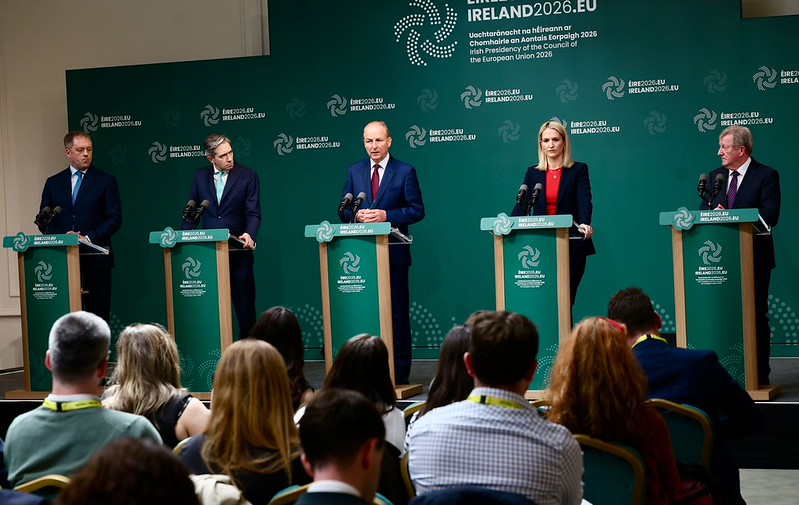
The Irish Presidency of the Council of the European Union began on 1 July 2026 and will continue until the end of December. During this period, the Presidency will focus on three key areas: competitiveness, EU foundational values, and security. Two of these — competitiveness and security — are particularly relevant to plant-based policy. Read on to find out what is at stake over the next six months.
The Presidency’s priorities
Competitiveness
The Irish Presidency aims to strengthen the Single Market by eliminating barriers, tackling regulatory burdens, and strengthening economic resilience. It also aims to strengthen internal market trade and trade with global partners, and ensure a level playing field for businesses operating across the EU. The Presidency also wants to make it easier for businesses to start up and grow seamlessly across the Union.
Security
Under the security pillar, the Irish Presidency has promised to address Europe’s security in all its dimensions, including environmental security. It will accelerate climate action at the EU and international levels and take a leading role in climate and biodiversity initiatives. The Presidency will also promote and develop the circular economy, strengthen economic security, improve health security, and reinforce Europe’s food security.
The link with Food and Agriculture
Protein diversification runs through both priority pillars, and it has already featured in the Presidency’s first weeks.
At the Grown in the EU event in the European Parliament on 24 June, the Presidency described protein diversification as a driver of generational renewal. It moreover expressed its willingness to advance on the Commission’s Vision for Agriculture and Food in which diversification, food security, and generational renewal constitute key priorities.
During its first AGRIFISH Council on 13 July, the Presidency emphasised that food security is integral to the EU’s overall security, and underlined the importance of a diversified protein supply and increased protein production across the EU. During the session the Irish Presidency promoted a discussion on the new Livestock Strategy and EU Protein Plan. The overall positive interventions set the tone for upcoming discussions to take place in the Special Committee of Agriculture, leading to the publication of a final report by the Presidency by the end of the year.
Diversification as a solution
Ultimately, food security in the EU is hindered primarily by insufficient production and consumption of plant-based proteins, which results in less efficient use of resources, land and public investment.
Growth in the plant food sector depends on cutting the red tape limiting market access and removing fragmented rules within the Single Market, precisely the barriers the Presidency has committed to tackling. It also depends on regulatory coherence in food law, so that the European plant-based value chain can expand and keep innovating. Lastly, ensuring a level playing field in public investment and taxation for farmers, processors and producers of plant foods is essential to achieve both security and competitiveness.
The Irish Presidency can play a key role in keeping up the discussions for an EU Action Plan for Plant-Based Foods, recommended by the Strategic Dialogue on the Future of EU Agriculture and by the Danish Presidency. It would design a coherent framework, also aligned with the goals of the new Protein Plan.
Increasing plant food production could generate new sources of income, reduce farmers’ vulnerability to price fluctuations and external shocks, and attract new talent to agriculture through modern, sustainable methods of farming. This is clearly shown in the Growing Resilience report by that interviewed 33 farmers across 18 Member States, finding that young farmers see plant production as an attractive financial opportunity and perceive agricultural diversification as a way to improve the quality of life.
Files to watch
The Presidency has committed to advancing the post-2027 CAP negotiations. It will also moderate discussions on the Common Market Organisation Regulation, a file that is directly relevant to the protein sector, an improved School Scheme, and plant-based denominations.
Other relevant files for agriculture and food will be advanced but not finalised: the Multiannual Financial Framework (the EU’s budget), the European Competitiveness Fund, and the 10th EU Framework Programme for Research and Innovation (Horizon Europe).